

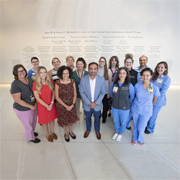
VCU Pauley Heart Center Nurse-Led HF Disease Management Team was named the 2022 Outstanding Heart Failure Care Team Award winner.
The Heart Failure Disease Management program at Virginia Commonwealth University Health (formerly the Medical College of Virginia) was developed to serve an under-resourced, inner-city community. It has evolved over the over the last decade to include arms intertwined to focus on (1) hospital transition to home, (2) chronic disease management and (3) remote monitoring. The dedicated nurses and provider are a selfless, hardworking group that has meaningfully impacted the community. Working together, the program has improved heart failure readmission rates (32% in 2014 to 18% most recently) and increased access to care. Below are the details of the program components and function.
Inpatient Heart Failure Navigator Team: The Inpatient Heart Failure (HF) Navigator team provides transitional care planning and education using a multidisciplinary team for admitted patients at VCU Health. Currently, the team consists of four baccalaureate-educated registered nurse navigators, a social worker and a pharmacist.
The nurse navigators identify HF patients using tools in our electronic medical record daily. Patients are screened for health literacy, depression, HF knowledge and special needs. One-on-one patient education includes self-care management, diet, medication, follow up and escalation of symptoms. Patients are provided tools to assist with their self-care including water bottles for fluid measuring, electronic bathroom scales that talk and an educational binder to refer to at home. Post discharge, the navigator makes an early phone call to review compliance with medications, patient weights, follow-up appointments and self-care management with the patient.
The team’s social worker contributes to the management of social deterrents to health working closely with area resources to improve patients’ ability to manage their care outside of the hospital setting. Such services include transportation to appointments, home health, elder caregiver services, food insecurities, financial needs and advanced care planning.
The team’s pharmacist contributes to patient education, program planning and patient treatment plans. This includes the spread of information across medical services to fellow pharmacists managing patients outside of a cardiology service line.
Outpatient Heart Failure APP Clinics: The teams’ outpatient APPs are the first-line follow up after hospital discharge for those patients in need of chronic surveillance and for urgent visits. The NP develops a medical plan and continues the patient education to transition the patient to long-term cardiology follow up. Additionally, they staff the infusion chairs for administration of ultra-high doses of intravenous furosemide (up to 300 mg) to help patients avoid hospital admission.
Outpatient Heart Failure Coordinators: Three baccalaureate-educated registered nurses coordinate outpatient heart failure care. These nurses are the point of contact for patients with questions and concerns. They created a booklet for the patient with important information: medication information, diet and exercise advice, and contact numbers. For patients, they clarify provider instructions, reinforce heart failure teaching, provide easy access for patient triage, and assist with medication-related issues including access to patient assistance programs and prior authorizations. In addition, the HF coordinators coordinate management of patients utilizing an implantable hemodynamic monitoring systems and coordinate weekly clinical check-ins with patients on intravenous home inotropes.