

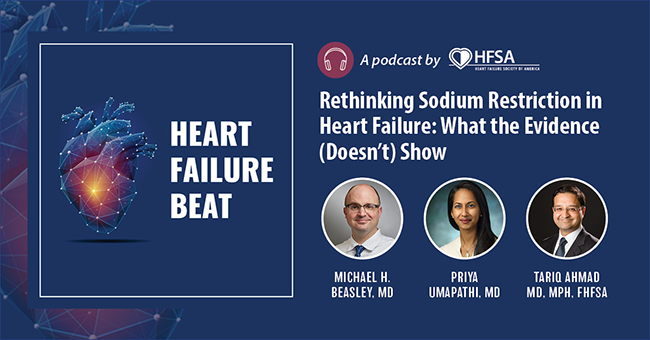
Sodium restriction is often presented as a foundational heart failure “rule” in clinic, discharge education, and inpatient care. But in the latest episode of the Heart Failure Beat, Dr. Tariq Ahmad argues that this long-standing recommendation has outpaced the quality of evidence supporting it.
Dr. Ahmad describes starting with a simple inpatient question: “Has anyone done a good study of inpatient sodium restriction?” His answer was unexpected: “The surprising answer was… no.” He notes that available studies were limited and methodologically inconsistent, with crossover designs and weak measurement of key variables—leaving clinicians without clear guidance.
That uncertainty has real-world consequences. As Dr. Ahmad puts it, “We focus a lot on the low sodium intake as a key aspect of patient self-care and prevention of readmissions, whereas there’s no data.” When patients return to the hospital, the narrative can shift toward blame: “They came in with quote unquote dietary indiscretion… whereas there’s no data saying that that’s the reason why anyone has worsening heart failure.”
Instead, the episode makes a case for refocusing. Michael Beasley raises the concern that sodium debates can become a “distractor” from interventions that do have strong support- especially guideline-directed medical therapy (GDMT). Dr. Ahmad agrees: “We should be doubling down on interventions for which we do have data. We have to be honest about things that we don’t have data for.”
So what should clinicians tell patients today? Dr. Ahmad recommends avoiding extremes: “Not… too salt restrictive,” noting signals that severe restriction (e.g., <1.5 g/day) may not be beneficial, while very high intake likely isn’t either. The bigger point: the field needs better answers.
To get them, Dr. Ahmad previews a pragmatic, EHR-embedded trial approach - building on prior randomized, embedded trials in his health system. He shares plans for SOAR-AHF, a study designed to compare a regular hospital diet versus a low-sodium diet for admitted heart failure patients, tracking outcomes like “length of stay, diuretic dosage, [and] 30-day readmissions.”
The take-home message is a call to move beyond tradition and toward “ground truth,” with better phenotyping and evidence that can support personalized guidance. As Dr. Ahmad frames it, this is part of a broader need in the field: despite meaningful advances, “there is a lot that needs to be done,” and heart failure remains “the final frontier.”
If your team counsels patients on sodium daily—or builds transitional care education around it—this episode offers an essential reset on what the evidence actually supports, what remains unknown, and what research may change next.
🎧 Listen now to this episode.